
The Biomarker Data You Need May Already Exist
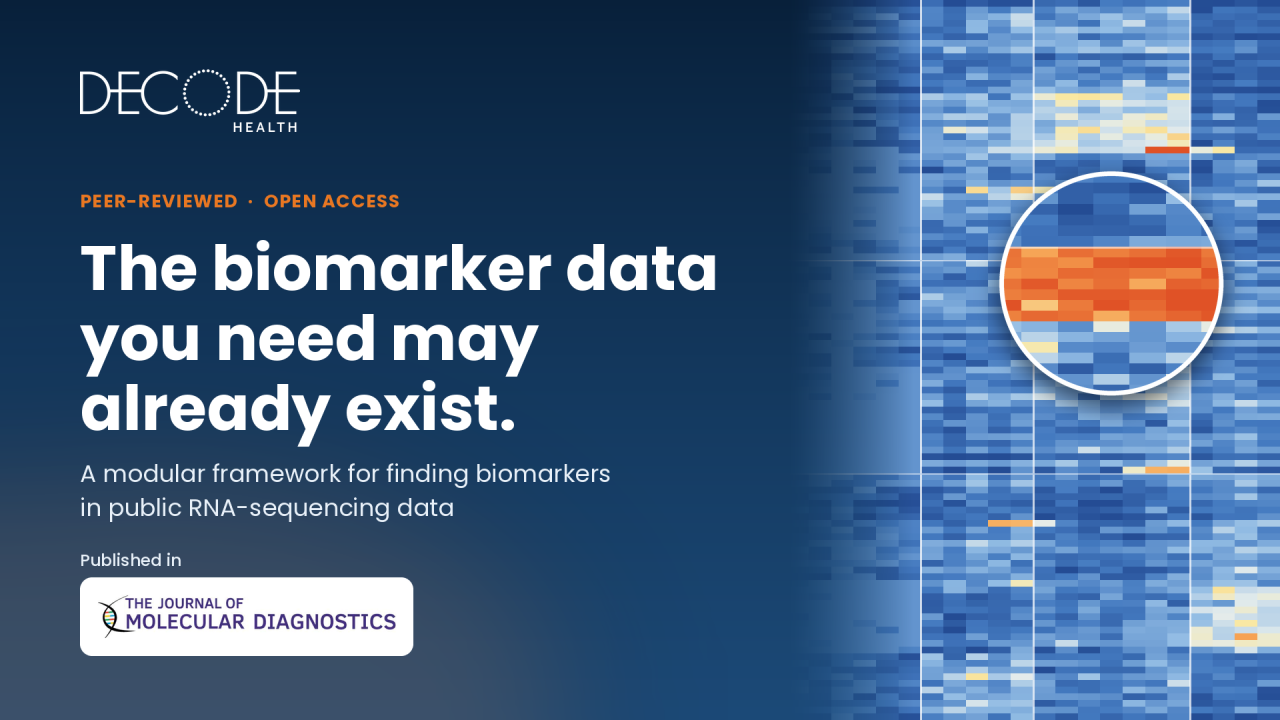
A modular framework that turns public RNA-sequencing data into usable findings, published in The Journal of Molecular Diagnostics and tested on three very different disease questions.
Most biomarker programs begin by generating new data. Our paper in The Journal of Molecular Diagnostics starts with data that already exists, sitting in public repositories and waiting to be used.
The Gene Expression Omnibus alone archives more than 200,000 studies and 6.5 million samples, accumulated over roughly two and a half decades of largely publicly funded research. Add the Sequence Read Archive and the number climbs further. This is research that has already been done and paid for. Very little of it gets reused for discovery.
The reasons are mostly practical. Some datasets are not good enough to use, and part of the job is recognizing which ones to walk away from. More often, public datasets rarely line up with one another. Study designs differ. Metadata is thin or missing. Files arrive in whatever state the depositing lab left them, from raw reads to aligned files to processed count matrices. Anyone who has tried to combine two public datasets knows what comes next. Weeks disappear into harmonization before anyone learns anything biological.
That makes it an analytics problem, and a solvable one. So we worked out how to build for it, and published the approach.
Meeting data where it is
The pipeline accepts data at whatever stage it arrives. Raw FASTQ reads are quality-checked, aligned, and quantified, applying the end-to-end total RNA-seq quality control framework our team published in JMD last year. Aligned BAM files go directly to gene-level counts. Processed count matrices enter at the count stage. From there, every dataset follows the same route through standardized QC checkpoints, differential expression, pathway enrichment, and competitive machine learning, with modules you can swap and re-run as the question changes.
Modularity matters for a practical reason. Public datasets arrive in different formats and different states of processing, so one fixed pipeline would fail on most of them. Interchangeable modules let each dataset enter where it makes sense and still meet the same standards downstream. That consistency makes results from different sources comparable.
The aim was to show the logic end to end, using examples simple enough to follow, and to show what public data can deliver when handled well.
We tested the framework on three questions our team worked through over several years, across a wide range of engagements. Each one asks something different. COVID-19 asks whether a 24-sample pilot can still say something useful. Sepsis asks whether separate cohorts, about 200 patients in all, can be combined into a panel small enough to use. Atherosclerosis asks whether bulk and single-cell data together can show where a drug target is active. A framework that holds up across all three has been tested under real conditions.
What a small COVID-19 cohort can still say
The first case was deliberately small, comparing whole blood from 12 critically ill COVID-19 patients against 12 non-critical patients. Beginning with raw sequence data, we looked across RNA biotypes instead of messenger RNA alone, which surfaced noncoding RNAs that poly(A)-targeted methods routinely miss.
The takeaway was about scale. Small pilot cohorts usually get labeled underpowered and shelved. Processed consistently, 24 samples still produced coherent, pathway-level biology worth pursuing.
From thousands of sepsis genes down to five
The second was harder. We combined 56 patients with sepsis and confirmed bloodstream infections, 65 with sepsis from peripheral site infections, and 80 non-septic emergency department controls.
We ran differential expression and competitive machine learning side by side, each catching signal the other missed, then narrowed to panels small enough to be translationally realistic. On a held-out test set, a 10-gene panel reached an AUC of 0.89 with 93 percent accuracy, and a five-gene panel reached an AUC of 0.86 with 89 percent accuracy. All of the panels outperformed published single-analyte benchmarks such as C-reactive protein and procalcitonin.
Corroboration mattered as much as performance, because it bolstered confidence in the signals we were capturing. More than 80 percent of the genes we identified already had published associations with sepsis, septic shock, or infection. Because the signal came from several independent cohorts rather than one, agreement across datasets did work that a single-cohort study has to defer to a later validation step. When separate patient populations point at the same biology, you are much less likely to be chasing an artifact.
Where an atherosclerosis drug target lives
The third case asked a different kind of question. NAPE-PLD is a candidate therapeutic target in atherosclerosis and other inflammatory conditions, and we wanted to know where it is expressed.
Across three cardiovascular cohorts, bulk specimens showed NAPE-PLD expression that was indistinguishable between cases and controls. Taken at face value, that reads like a dead end. Adding publicly available single-cell data changed the picture entirely. In a mouse model of atherosclerosis, expression was concentrated in specific macrophage populations inside the plaque. In human ischemic cardiomyopathy, the macrophage clusters with higher NAPE-PLD expression also showed reduced MERTK, an efferocytosis gene, pointing toward cell-specific impairment in diseased tissue.
That distinction carries real weight for target development. A signal invisible at bulk resolution and confined to specific macrophages changes how you design the next study and how you think about on-target and off-target effects, well before anyone commits to a prospective cohort.
Knowing where a signature holds
One of the most useful results draws a boundary. Our sepsis panels were built to recognize sepsis caused by bloodstream infections, and they did on held-out data. For patients whose sepsis began with an infection elsewhere in the body, accuracy was 59 to 72 percent, suggesting the same diagnosis can hide different biology.
That is the framework doing its job. A signature is most useful when you know exactly where it applies, and learning that from public data costs far less than learning it in a validation study after a program is committed.
The same discipline shaped the machine learning. All preprocessing and feature selection happened inside cross-validation folds, with evaluation on data the models had never seen. Information leakage can make weak biomarker models look strong, and it is one of the most common reasons a striking result fails to reproduce elsewhere.
Separating conditions that look alike is work we have already advanced. In a separate JMD study, our models distinguished neuromyelitis optica from relapsing-remitting multiple sclerosis, two conditions that can look alike but call for different clinical care. The best model reached 94 percent accuracy on a held-out validation set.
Gene expression is one layer of what a single sample holds. The same sample also carries information on immune type, immune receptors, genetic variation, and cell composition. Reading those layers together is how we are taking this work further.
Where this fits in a real program
Prospective studies are still where a biomarker gets proven. Public data tells you which ones are worth running.
Used well, it expands effective cohort size, tests whether a candidate biomarker behaves the way a hypothesis requires, and reveals which tissues and cell types actually matter, all before a program commits real time and budget. In a field where a new therapy can take over a decade, and much of the early effort goes to wrangling data before the science starts, compressing a first pass from years into months is meaningful de-risking.
It also reflects how we work. Most precision medicine teams sell software or services. We deliver the findings themselves, and a finding is only worth something if the method behind it is reproducible, the guardrails are real, and we are clear about where it holds.
The paper is open access, and the approach is laid out so the logic is easy to follow. The model architecture we have tuned across partner programs, the proprietary data estate those programs draw on, and the methods we use to refine those signals and derive new ones from raw data all stay in-house.
The data you need may already exist. The work is knowing what to do with it.
Read the article on LinkedIn